


I used to fear the red pen in Julia’s hand.
In my early days of preaching regularly, Julia was my faithful editor. She is a gifted exegete and writer. You can add these traits to the very long list of reasons why I’m fortunate to be married to her. Another trait? Julia is no pushover. When she edits, she takes Proverbs 31:17 literally. She pulls no punches. I would hand her a manuscript expecting minimal revisions—deluded about the state of my draft. After Julia’s touch, my pages turned into abstract art: random cross marks and circles, sentences scratched out, and scribbled notes. My ego was easily wounded. I was overly defensive. Sometimes arguments ensued. Yet what really gnawed at me? Every stroke of her red pen, every suggestion or new thought: each added minutes and hours of time to invest into the sermon. It often felt like additional time I didn’t have to spare.
Julia served as my editor for many years. Over time, I softened to the process. We learned to collaborate well. I can’t pinpoint when it happened: Julia stopped editing my drafts. It wasn’t intentional. It was the combination of growing in my maturity as a preacher and (more likely) the fullness of raising children and Julia’s own work as a counsellor.1
When Poetry Messes With You
Tucked away in a footnote in my last article, I named a few ways I’ve experimented with AI for sermon development. For clarity: I do not use AI to write sermons for me. But I have used it to analyze sermon drafts, using prompts to identify logical gaps, clunky transitions, or clutter and redundancies. The machine might make suggestions; I decide what to do with it. In my footnote I confessed:
I admit: I have used AI in a way that takes the work out of others hands. What I mean is that the expediency of its results is easier than waiting for someone to be both available and ready to give feedback by the time I need it. I feel great reticence about it too.
The potential time-saving promises of AI are a great temptation for me. Time is my most precious resource. I love using it well and productively. But my reticence about the gain of efficiency at the cost of relational interdependence grew into a gut punch after I read the poem Please Use AI by Shawn Smucker. Here is the opening stanza:
Be sure to use AI when makings
your next, I don’t know, meal plan,
for example. Definitely do not call
your friend who loves to cook and ask her
for her favorite recipes or tips or ways
to save time making meals,
because you will end
up talking for longer than you had hoped,
hearing, perhaps, about her father’s cancer
diagnosis or how lonely she’s been or even
what she’s planted in her spring
garden and then lost with the early frost.
When we take work out of human hands? We also take away some of our shared humanity. Contrast Smucker’s poem with the concluding stanza of All Watched Over by Machines of Loving Grace written in the 1960s by Richard Brautigan:
I like to think
(it has to be!)
of a cybernetic ecology
where we are free of our labors
and joined back to nature,
returned to our mammal
brothers and sisters,
and all watched over
by machines of loving grace.
Machines of loving grace? Is it too much to say this is idolatrous? Perhaps the poem is ironic. Then I can tip my hat. I don’t think it was. And I do not wish to be watched over by machines of loving grace.
In his encyclical, Pope Leo XIV identifies how the trans/post-humanist myths behind AI make the promise of becoming “more than human”: be it overcoming our limitations, maximizing possibilities, and even merging with machines. Brautigan’s poem suggests we will become “more” as the machines free us to be truly human, as we once were, presumably in some idyllic past. Grace upon grace!
Pope Leo rightly points out that this promise isn’t new. It won’t be attained via the myths of the trans/posthumanists or the vision of machines of loving grace. Becoming “more than human” is the telos of the gospel: the grace of God perfects our nature through participation in the divine life. By the power of the Spirit, we become alter Christus, ipse Christus: another Christ, Christ himself. This is not simply a return to a more primitive state, or a retrieval of a nature once lost nor an abandonment of it. This is the nature of new creation. All watched over by the God of loving grace.
This is the question this raises for me:
What kind of “more than human” is AI developing in me?
What We Give Up When We Hand Off the Work
Let’s return to another voice among the Resistance. When answering the question “Should you use AI to write?” Yann Martel, author Life of Pi, responded:
Why would I? It’d be like hiring someone to have sex for you. For anything creative, why would I want to use it when it’s the very creative language that I like?
The shock value serves a purpose. There is something so innately human and sacred about sex, that even if you could delegate the task: why would you? For what purpose? The conversation about AI often feels ambiguous. This analogy provides a clean boundary and transgression. It presses us to consider: What tasks of humanity are fundamentally ours? When does handing over the work become absurd?
I believe the work of preaching is sacred. This includes the development and delivery of sermons. Why would I want to let AI write the sermon for me when I would never allow it to preach it for me? And why would I use AI to write if that is the very work that I am called to do?
Now, like any sacred work, crafting a sermon includes the mundane. To delegate some of these tasks to AI does not automatically profane sacred work. That might be the position of some of the Resistance. But it is not yet mine. However, the sacred and mundane are so entwined that pulling at one might unravel the whole.
Consider the Levites. Delegation within sacred work was built into the system. Distinct tasks for clans. Oxen and carts provided for the heavier loads. There were limits: the Kohathites had to carry the ark on their shoulders—no carts. Even removing the altar’s ash was priestly work. I’m sure they would have preferred not to handle all the cleanup. The mundane was part of the sacred work. A principle emerges here: The closer to the holy, the less could be handed off. For preachers: what is nearest to the holy? Exegesis, prayer, proclamation: they stay in your hands. What tasks can we hand off to others, even AI?
David Swisher thoughtfully identifies some options for people in ministry. His proposal is based on the conviction that AI can be used to protect one’s capacity for the work that only they can do. In respect to sermon development, his principle is:
AI at the front of the process, the pastor’s discernment and prayer over all of it, and transparency instead of concealment.
I only deviate from this slightly—in process, not principle. I prefer not to use AI at the front of the process (this is not a slight against those who do). I have used it toward the end of the process: only after I have completed my exegesis and research and written a full draft. At this point, AI can help me see my manuscript from another vantage point. It makes suggestions for areas of improvement as I continue to make revisions myself. The final product is always my own writing and work.
Swisher argues AI can be deployed as delegation not abdication. It frees time for other priorities such as prayer and pastoral care. I want to point out that this delegation comes with a cost, however. The experienced homiletican or writer may save time and possibly risk atrophying their skill, whereas the person new to the craft will circumvent their formation. AI can improve your manuscript or notes. I am not persuaded that it can improve your skill.2
Returning to The Human Hand
As a card-carrying member of the Resistance, Julia rebukes me for using AI at all, especially for my experiments with it in sermon development. She would rather a bad sermon than an AI edited one, an unprepared sermon than a last minute machine-generated one (I have never done the latter). She said: “If you’re using AI because I’m not available, I will make time.” Since we are in a different stage of life now: I accepted the offer.
This past week, we returned to the tried and true method of Julia’s red pen. Except, it wasn’t a red pen. It was a shared Google Doc with comments. Life is still full. We had to work around each other’s schedules. I ended up having to exercise patience while I waited for Julia to provide feedback. But in that gap? I turned to prayer and meeting with people for pastoral care. (It turns out that the limits of waiting on another human being can open up space just as much as the efficiency of AI can. Go figure.)
Of course, compared to AI, I appreciate the personal touch of Julia’s comments. But I also observed something AI cannot do: it cannot have a truly human experience of reading a manuscript, not knowing where it will ultimately go, and sharing reactions real-time. Of course it can try to emulate such a reading and feedback. But it can only parody and never embody the person in their context and culture. It could never truly provide comments like the following:
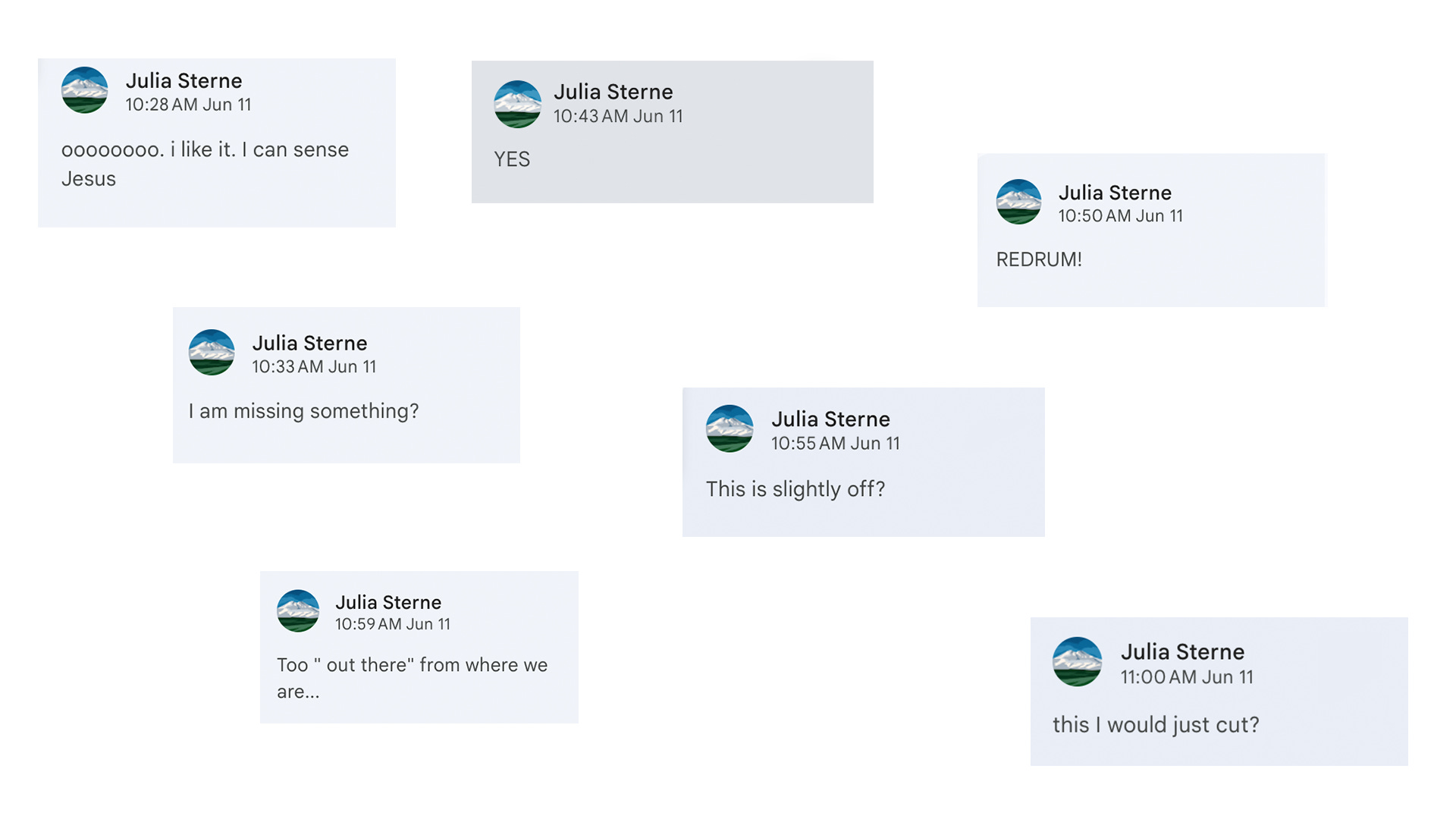
Julia’s comments mid-read aren’t always spot-on (neither are Claude’s). They sometimes reflect someone reading quickly. But then again, they also predict (dare I say prophesy) the experience of all who will hear the sermon. I know where we are going. My dear church does not. And even despite our best efforts, God knows how we can get lost during a sermon (no matter how certain the preacher may be about clearing the path).
Should I continue to work with AI rather than Julia (or others), I would also lose the light-hearted comments that help me take myself less seriously—like her allusion to The Shining on sermon about Cain and Abel.3 While AI can compile a lot of useful information, I fear losing the substantial reflections offered by another person. Julia’s comments below are not merely an amalgamation of data into the most probable sequence of words. They express her experience and embodied faith:
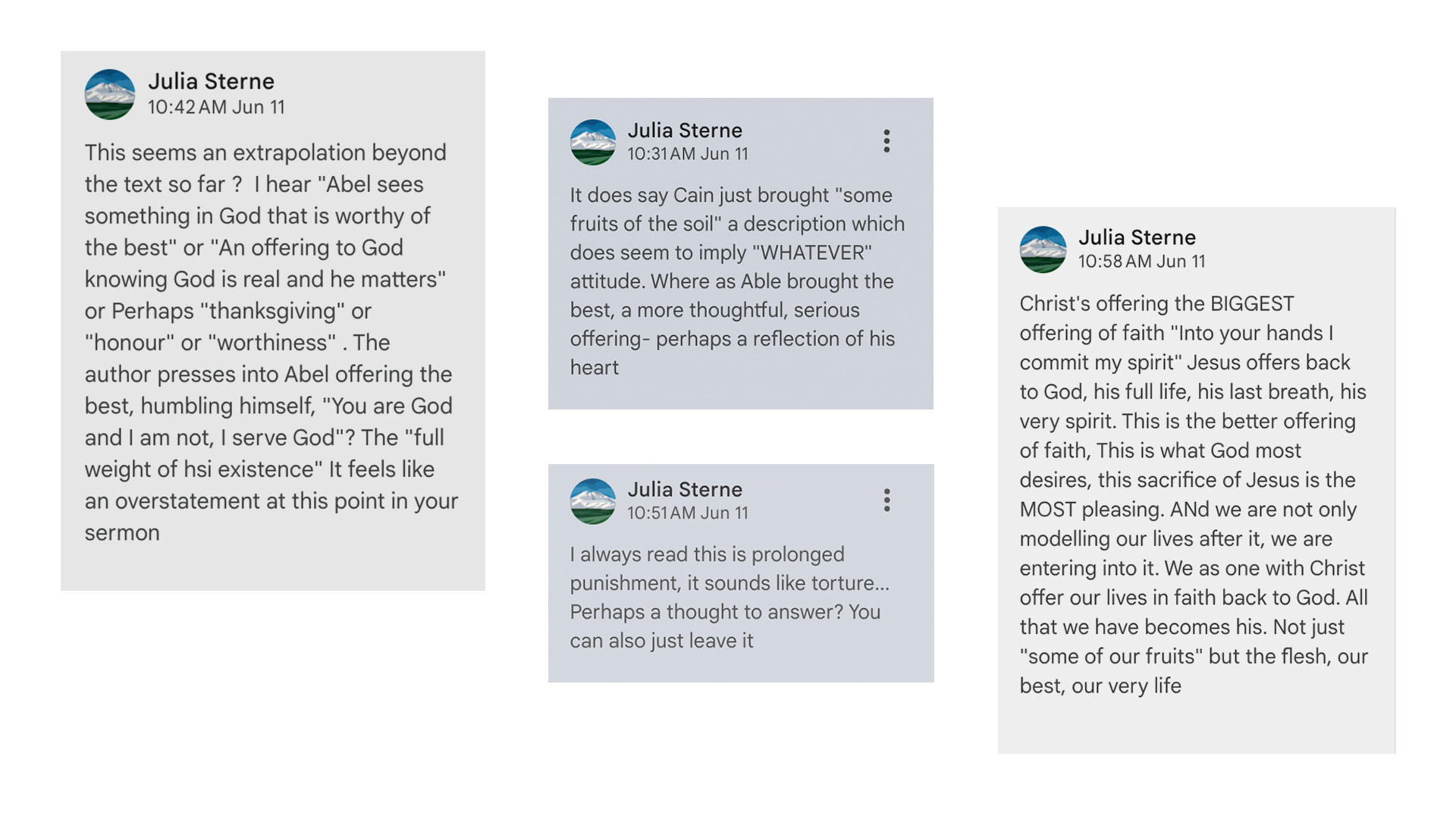
As I wrestle with Julia’s comments, I enter into the mutuality of human understanding. Sure, I can “dialogue” with AI. It can go back and forth with me. It can quickly analyze relevant data points and consolidate them into relevant feedback. But it holds no true opinion or interpretation. Because it does not have one. The best feedback offers an opinion you must consider.
What did I learn from this experiment?
AI might save you some time. But that depends on a lot of factors. For me? Returning to my old process didn’t take that much longer. Was my sermon any better or worse for it? I can’t say. You’d have to ask the good people of Coastline. But it was fully human.
More importantly, this experiment with Julia revealed a more substantial loss in delegating tasks to AI. Here it is:
Bear one another’s burdens, and so fulfill the law of Christ.
Galatians 6:2
AI offers quicker results. But what if the shortcut is actually a detour from fulfilling the law of Christ? Although Julia enjoys helping me, I burden her with my work. It becomes our work. She sacrifices time to read, reflect, and provide feedback somewhere between working full-time and raising a family and pursuing her own interests. Similarly, I bear the burden of waiting, putting any further revisions on hold, and not finishing my manuscript as quickly as I’d prefer.
The list of mutual burden bearing could be detailed further. But it comes full circle to Shawn Smucker’s poem. I’m no poet. But here’s my stanza:
Be sure to use AI, if you’d like to miss
the exchange of thoughts and ideas
about Cain and Abel and our shared
humanity. Who needs to become
“more than human” through bearing
burdens when the Machine
never feels the weight.
I must temper my critique slightly. Although AI does circumvent bearing burdens in one way, this doesn’t necessitate that it does so in every way.
Finally, the question isn’t whether or not humanity should ever extend its capacity. We do that all the time. Different modes of transportation move us from one place to another with more expediency, and washing machines and dryers free us to do other things. However, the comparison breaks down. AI is not a tool or device like a car or household appliance. It can extend our capacity well beyond human limits. This will be for good and ill. But I am starting to feel the argument for increasing our capacity to do more of the right work is a red-herring. The question gnawing at me is: As we draw near to the holy, when does delegation to AI become an abdication of the holy?
My experiment opened up more areas for me to contemplate. Many of my thoughts here are provisional. My last article brought about many wonderful conversations. I hope this one does the same.
This doesn’t mean that I’ve stopped needing input on my drafts. I’ve always tried to involve people in my sermon development process. Because I’m convinced we better hear the Spirit in relationship.
I admit AI can do a fine job as an editor. But it can only raise the floor—not the ceiling. It can help a bad writer be an average one. I doubt an average writer can become a gifted one with AI. So long as your goal is mediocrity and predictability, AI will not disappoint. Perhaps this is too critical. I may be wrong. But I may be right.
I refuse to let the Machines take the em-dash from us. It’s not always a sign of AI!