


When I was nineteen, I loved to go ghost-hunting.
Most nights, I worked at the pizza shop, then went ghost-hunting with friends. Two or three nights a week, I had rehearsals with my band, then we’d pile into a car and go ghost-hunting. Bastion Square. Ross Bay Cemetery. And most of all, the Uplands Golf Course—one of the most famous ghost sighting places in North America. The story was that a woman was murdered on her wedding day and you could see her standing in her dress crying.
For about four years, I went at least once a week.
We never saw anything.
Admitting you used to hunt for ghosts can take people by surprise. I can see them trying to figure out if I’m joking.
But strip away the ghost-hunting and what you’re left with is this: I was searching for transcendence. I wanted evidence that the material world wasn’t all there is.
During that time, I read everything I could find on the New Age shelf. Hinduism, Buddhism, everything in-between. The Celestine Prophecy told me every event has significance, contains a message. This resonated. I had questions: Who am I? Do I matter? Is there something to this life?
I remember sitting cross-legged in a yoga studio, crystals arranged like some spiritual Stonehenge. I sat there for an hour, then two, even three, waiting to feel something. Anything.
Nothing.
I opened my eyes to the same blue yoga mat, the same restless questions. The crystals looked like overpriced rocks.
Just another kind of ghost hunting.
One time, I was ghost-hunting with a friend who was in a Christian hardcore band. Yes, those exist. We were at Uplands, waiting in the cold for a dead bride who never showed.
He kept asking me what I thought life was all about.
I gave him my usual answers: “Being a good person. Caring for others. Doing meaningful work.”
“And how’s that going for you?”
It bothered me.
So I started telling him about my beliefs—the stuff I’d been reading, my theories about the universe and consciousness. The significance of events. The synchronicity of 11:11. The inner true self.
“And how’s that going for you?”
The more I thought about it, the more I realized it wasn’t going well.
I went silent.
Finally he said, “Alastair, if Jesus is really who he said he is, isn’t that worth finding out?”
Chris wasn’t pushy. He was thoughtful. Yet challenging.
I remember thinking, “I wouldn’t mind being more like this person.”
That was new. Christians, in my limited experience, were people to avoid—mostly boring with rules I had no interest in following.
But this person was different.
I kept playing shows. Kept searching. And Christians kept appearing in the strangest places.
I was at a party one night, sitting on a purple couch. A friend I’ll call Greg sat down next to me. He was in another band. He had this incredible falsetto—could just hit those notes. And he was a few notes away from being sober.
He started talking to me about Jesus.
I pushed back with my spiritual-not-religious drill.
He listened. Nodded. Then he said, “Alastair, I hope you know one day how much Jesus loves you like I know how much he loves me.”
I wanted to say, “Look at you. You’re in a worse state than I am right now. And you’re talking about Jesus loving you?”
But I didn’t.
What he said messed with me. I’ve never been able to forget it.
A few months later, everything I’d been working toward fell apart.
My band was on the verge of a record deal—the thing we’d been chasing for years—and then they decided they needed a better singer.
The problem was that I was the singer.
Deep down, I didn’t disagree. It was their shot. I think that’s what made it hurt: the truth. Not being good enough.
I was done. With music. With searching. With all of it.
Late one night, I was driving down the Pat Bay Highway at 2 AM. I took my hands off the wheel.
“If there’s a God,” I said to the empty car, “I mean it. If you don’t show up, I’m done.”
Then I had a thought. But it felt like it had been dropped into my head from somewhere else: Put your hands back on the wheel.
I did.
Then more thoughts. Turn left. Turn right. Turn right again. Turn left.
I followed them. Maybe it was just my subconscious in self-preservation mode. Maybe it was something else. I believe it was.
I ended up in a parking lot I’d never been to. Beyond the lot was woods. Beyond the woods was ocean.
I felt like I was supposed to walk into those woods.
I did.
It was terrifying. I was alone. I had no idea what I would find. I kept walking until it was too dark to go further.
I stopped.
And then that same thought-drop happened:
Even if the darkness overcomes you, I am with you.
I thought, “I’ve lost my mind.” You know you’re in bad shape when you start thinking in the third person.
But I couldn’t shake it. I’d had some sort of encounter with something more. For the first time in my life.
Three days later, another friend gave me a book. A Christian book.
I’d never read one. I didn’t want to read it. The author in his bio photo was a fat man wearing a Hawaiian shirt. “What on earth could a guy in a Hawaiian shirt teach me about life?”
She convinced me.
I hated parts of it. But it was the first time I’d read anything about Jesus for myself.
I discovered that Jesus was called Emmanuel, which means “God with us.”
A lightbulb went on. That must have been who was with me in the woods. In the darkness. In the uncertainty and hopelessness and confusion of my life. God with me. Even there.
I’d always thought Christianity was for people who drew within the lines. But when I encountered what happened in those woods—I wasn’t okay. I didn’t have my life together. I was falling apart and taking others down with me.
I didn’t deserve God.
But apparently that was the point.
Greg was right.
Eventually, I became a follower of Jesus. Gradually, like someone learning to see in the dark.
That was over twenty years ago.
And I’m still finding God in unexpected places.
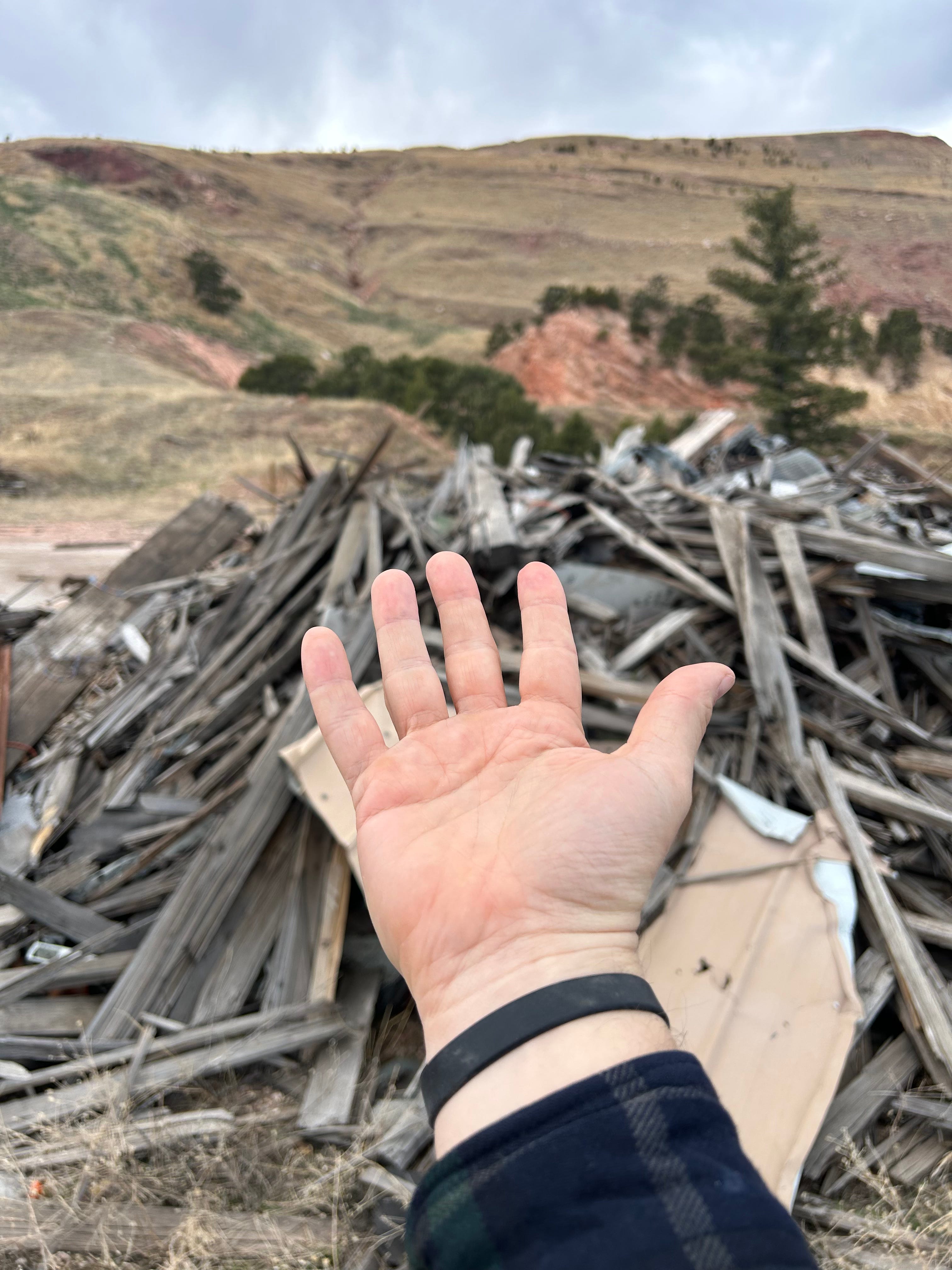
More recently, I was hiking the Echo Rock Canyon Trail in Glen Eyrie, Colorado. I reached an open clearing—rolling pastures, billowing clouds, snow-capped Rockies with red rocks jutting forth. And at the center: a pile of rubble.
The remnants of an old building. Strange to discover uncollected garbage in the middle of all this beauty. But within the rubble, Desert Spoon stood tall and golden.
It felt like an altar.
I was tempted to take my shoes off. Then a song came on my playlist, sung to Jesus about the complications of his church: “Do you ever feel misunderstood by what this thing has become?”
That week I’d been in meetings discussing the future of the church. At times, I didn’t know what to make of the complicated thing that the church is. It can feel like a heap of rubble that includes all my best and good works.
But standing there, I felt it: we’re surrounded by the grace and love of God. I was overwhelmed. Joy like waking from sleep, wiping the haze from my eyes.
I picked up a discarded rubber band. Put it on my wrist. A reminder.
Even if our best efforts turn to rubble—God is still there.
God with us.
At nineteen, I was stumbling through the Uplands golf course in the dark, looking for a murdered bride in a wedding dress, crying somewhere in the shadows.
I never found her.
But I’ve kept looking. For transcendence. For presence. For signs that there’s something more than what we can see.
I still hunt for ghosts in a way. But now I know what I’m looking for.
God in the rubble. God in the woods at 2 AM when everything’s fallen apart. God in a Hawaiian shirt. God on a purple couch. God in the cold waiting for a dead bride who never shows.
I still haven’t seen a ghost.
But I’ve learned something: the world is haunted by grace.
I love the idea of the world being haunted by grace! What a lovely thought, it makes me want to keep looking for it.
I absolutely loved this!
As a young teen, I was also fascinated by the supernatural. I'd scour the topics of talk shows (in those brief descriptions in the TV guide ... no internet back then) for anything that mentioned ghosts, psychic activity, life after death, etc. I didn't know what I was looking for.
I didn't like horror or vampire stories; I understood there was a dark side and I had grown up with enough anxiety and fear to stay away from that, lol. But the idea of something beyond drew me.
Years later, in my adulthood, I memorized Francis Thompson's "Hound of Heaven." It's remarkable, isn't it, how often we are drawn to Him by some strange and unexpected avenue, all along hearing and half-fearing that footfall of pursuit?
In all the searching, He waits for us to stop so He can say:
"Ah, fondest, blindest, weakest,
I am He Whom thou seekest!"